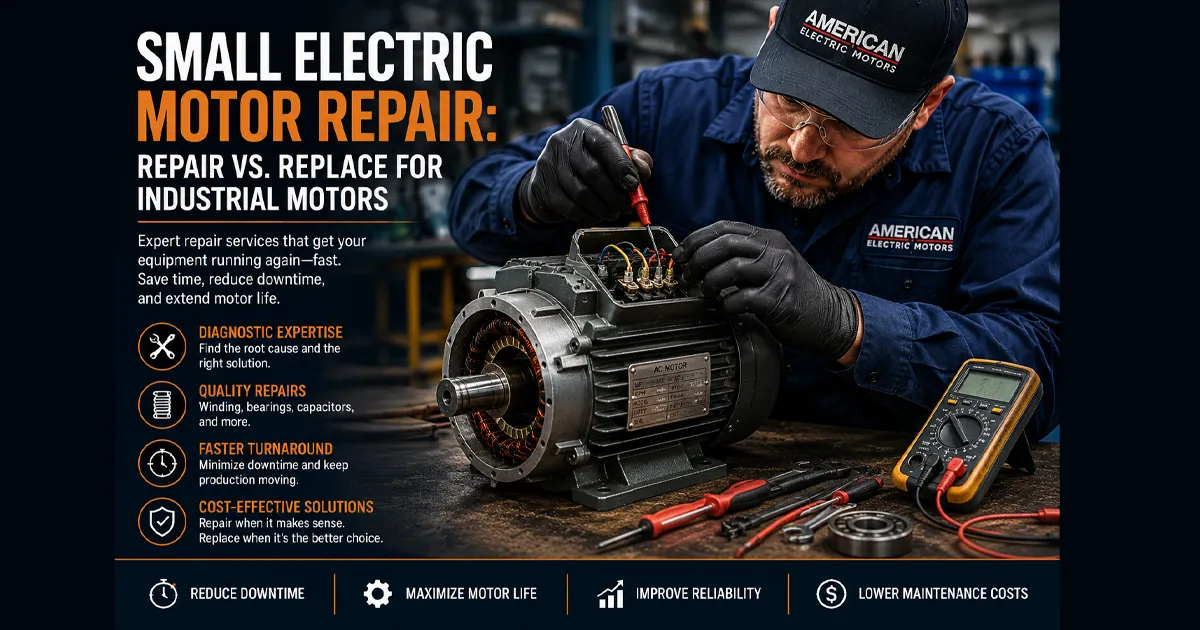
Small electric motor repair can be one of the smartest maintenance decisions for industrial and commercial equipment. While some small motors are inexpensive and easy to replace, many are connected to machinery where downtime, lead time, mounting requirements, custom windings, or production demands make repair the better option.
American Electric Motors provides electric motor repair for small, fractional, sub-fractional, AC, DC, and specialty motors. Our team helps industrial customers determine when small electric motor repair is worth it, when replacement makes more sense, and how to maximize long-term reliability.
What Counts as a Small Electric Motor?
In many industrial settings, small electric motors include sub-fractional, fractional horsepower, and lower-horsepower motors used in compact equipment or auxiliary systems. These motors may power:
- Conveyors
- Pumps
- Blowers
- Fans
- Gearmotors
- Small presses
- Packaging equipment
- Food processing equipment
- Automation systems
- Hoist and crane auxiliary functions
- HVAC-related machinery
- Specialized OEM equipment
For a broader overview, see American Electric Motors’ guide to small electric motors.
Why Small Electric Motor Repair Is Not Always “Small”
A small motor can create a major problem when it stops a production line. The motor may be inexpensive, but the downtime is not. A failed blower motor, conveyor motor, pump motor, or control-system motor can delay orders, reduce throughput, damage equipment, or create safety issues.
That is why small electric motor repair should be evaluated based on total cost, not just motor price.
Consider:
- Cost of downtime
- Replacement lead time
- Fit and mounting requirements
- Motor customization
- Machine age
- Availability of OEM replacement parts
- Urgency of production
- Long-term reliability
Common Small Electric Motor Problems
Small motors fail for many of the same reasons as larger motors, but they often have less room for heat, dust, and mechanical stress.
Bearing Failure
Worn bearings can cause noise, vibration, heat, and rotor misalignment. If ignored, bearing failure can damage the shaft, rotor, stator, or housing.
Winding Damage
Windings can fail from overheating, overload, voltage problems, moisture, or age. Small electric motor repair may include rewinding when the motor is valuable or custom.
Overheating
Blocked ventilation, overload, poor duty-cycle matching, and dirty environments can cause overheating. Heat shortens insulation life and can lead to sudden failure.
Contamination
Dust, oil, metal particles, chemicals, and moisture can reduce insulation resistance and damage bearings or windings.
Capacitor Failure
Single-phase motors may have start or run capacitor issues that cause hard starting, humming, overheating, or failure to start.
Brush Wear
Small DC motors may use brushes that wear over time. Worn brushes can lead to sparking, poor torque, and commutator damage.
Signs You Need Small Electric Motor Repair
Schedule inspection if you notice:
- Humming without rotation
- Slow startup
- Overheating
- Burnt smell
- Tripped overloads
- Visible sparks
- Noisy bearings
- Excessive vibration
- Reduced output
- Repeated capacitor failure
- Motor stalls under load
A quick diagnostic can prevent a low-cost repair from becoming a full replacement.
Repair vs. Replace: How to Decide
The U.S. Department of Energy’s motor system resources encourage looking at motors as part of a larger system. The right decision depends on performance, cost, reliability, and application needs.
Choose Small Electric Motor Repair When:
- The motor has a custom shaft, mount, frame, or winding
- Replacement lead time is too long
- The motor is part of a matched system
- Downtime costs exceed repair cost
- The motor is obsolete or hard to source
- The failure is limited to bearings, windings, leads, or capacitors
- The equipment requires a specific OEM fit
- Repair can restore dependable operation quickly
Choose Replacement When:
- The motor is standard and readily available
- The repair cost approaches or exceeds replacement cost
- The motor has severe frame, core, or shaft damage
- A newer motor provides better long-term performance
- The application has changed and the existing motor is undersized
American Electric Motors can help with both repair and new motor sales when replacement is the better long-term decision.
What Happens During Small Electric Motor Repair?
A professional small electric motor repair process may include:
1. Initial Inspection
The motor is checked for visible damage, contamination, overheating, loose leads, cracked housings, worn bearings, and shaft issues.
2. Electrical Testing
Testing may include winding resistance, insulation resistance, capacitor checks, and continuity checks. The Megger Guide to Insulation Testing explains how insulation testing supports motor maintenance decisions.
3. Mechanical Evaluation
Technicians inspect bearings, shafts, fits, cooling fans, seals, and alignment surfaces.
4. Cleaning and Repair
The motor may be cleaned, dried, reconditioned, rewound, fitted with new bearings, repaired mechanically, or rebuilt depending on the issue.
5. Reassembly and Testing
After repair, the motor should be tested to confirm proper operation before returning to service.
Safety and Maintenance Considerations
Small motors can still be hazardous. Before any inspection or maintenance, equipment should be de-energized and serviced according to proper safety procedures. OSHA’s lockout/tagout standard addresses control of hazardous energy during servicing and maintenance.
Preventive maintenance also matters. Keep motors clean, protect them from moisture and contamination, monitor heat, listen for bearing noise, and document repeated failures. A repeated “small motor problem” may point to a larger system issue such as overload, poor ventilation, misalignment, voltage imbalance, or incorrect motor selection.
Why Choose American Electric Motors for Small Electric Motor Repair?
American Electric Motors has more than 50 years of experience with AC and DC electric motors. Our team repairs and services motors from sub-fractional horsepower to 2000 horsepower, giving customers one source for small motor repair, large motor repair, rewinding, diagnostics, and replacement options.
We help customers:
- Maximize motor lifespan
- Lower maintenance costs
- Reduce downtime
- Restore reliable performance
- Diagnose recurring failures
- Source replacement motors when needed
- Customize windings for special applications
Request Small Electric Motor Repair
If your small motor is overheating, humming, vibrating, failing to start, or causing equipment downtime, do not guess. Get a professional diagnosis.
Contact American Electric Motors through our Sales and Service Request page for small electric motor repair, rewinding, diagnostics, and replacement support.