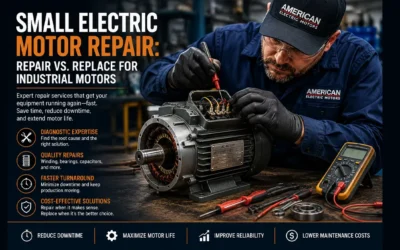
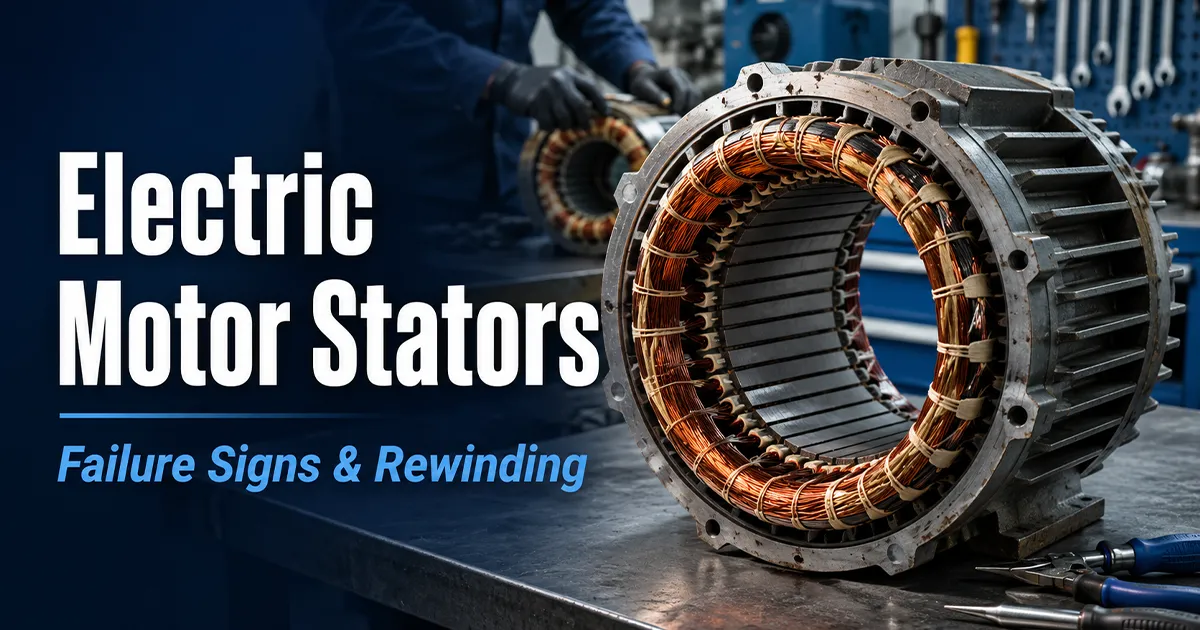
Electric motor stators are the stationary electromagnetic heart of most industrial AC motors. When a stator winding begins to fail, the motor may run hot, draw uneven current, lose torque, trip protection devices, or stop completely. Understanding the stator’s role—and knowing when testing, repair, or rewinding is appropriate—can help a facility avoid extended downtime and an unnecessary motor replacement.
American Electric Motors has more than 50 years of experience diagnosing, repairing, rebuilding, and rewinding industrial AC and DC motors. Our in-house capabilities allow us to evaluate the electrical and mechanical condition of a motor before recommending the most practical path forward.
What Is an Electric Motor Stator?
The stator is the fixed portion of an electric motor. In a typical AC induction motor, it surrounds the rotor and contains a laminated steel core with insulated copper windings installed in precisely arranged slots. When alternating current passes through those windings, it creates a rotating magnetic field. That magnetic field induces current in the rotor and produces the torque that turns the shaft.
The stator must maintain the correct winding pattern, turn count, conductor size, phase balance, insulation integrity, and air gap relationship. A defect in any of these areas can change the motor’s magnetic field and electrical performance. The National Electrical Manufacturers Association develops and maintains the NEMA MG 1 motors and generators standard, which addresses construction, performance, testing, and application considerations for electric machines.
Stator vs. Rotor: What Is the Difference?
The stator remains stationary while the rotor turns inside it. In an AC induction motor, the stator produces the rotating magnetic field and the rotor responds to that field. The rotor transfers the resulting mechanical power through the shaft to a pump, conveyor, fan, compressor, crane, or other driven equipment.
Although stator and rotor problems can create similar symptoms, they require different testing and repair procedures. A motor that overheats may have shorted stator turns, but it may also have damaged rotor bars, bearing friction, misalignment, ventilation problems, an overload, or an incorrect power supply. That is why a complete inspection matters before anyone assumes the stator needs rewinding.
Common Signs of Stator Winding Failure
Stator problems often develop gradually, especially when heat, moisture, contamination, voltage imbalance, or repeated overloads weaken the winding insulation. In other cases, a single electrical event can cause immediate damage.
- Repeated overload trips or blown protective devices
- Excessive heat or a burned insulation odor
- Uneven current between phases
- Low insulation resistance or a winding-to-ground fault
- Reduced torque, difficult starting, or failure under load
- Abnormal humming, vibration, or noise
- Visible discoloration, damaged lacing, or burned windings
These symptoms are warning signs rather than a final diagnosis. Continuing to operate a motor with an electrical fault can spread damage to the core, rotor, bearings, shaft, and connected equipment. Prompt professional testing usually provides more repair options than waiting for a catastrophic failure.
Why Electric Motor Stators Fail
Excessive Heat
Heat is one of the leading causes of insulation deterioration. High ambient temperature, blocked cooling passages, repeated starts, overloads, poor ventilation, or operation outside the motor’s intended duty can accelerate insulation aging. Once insulation becomes brittle or carbonized, adjacent turns may short together and create even more heat.
Voltage Problems
Voltage imbalance, phase loss, overvoltage, undervoltage, and transient spikes can place abnormal electrical stress on stator windings. Even a small phase imbalance can produce a much larger current imbalance, increasing operating temperature and reducing motor life.
Moisture and Contamination
Water, oil, conductive dust, chemicals, and process debris can reduce insulation resistance and interfere with cooling. Motors used outdoors, in washdown areas, around metal dust, or in corrosive environments require the correct enclosure, seals, insulation system, and maintenance practices.
Mechanical Stress
Loose windings, vibration, rotor-to-stator contact, damaged bearings, or an uneven air gap can physically damage insulation. A purely electrical rewind will not solve a mechanical condition that caused the winding failure, so the complete motor must be inspected.
How Electric Motor Stators Are Tested
A professional evaluation begins with the motor’s nameplate data, application history, operating symptoms, and condition as received. Technicians then inspect and test the motor to determine whether the fault is in the stator, rotor, bearings, shaft, connection system, or another component.
Depending on the motor and failure, testing may include insulation resistance, winding resistance, phase balance, surge comparison, high-potential testing, core-loss testing, visual inspection, bearing evaluation, shaft measurements, and vibration or balance checks. The results help distinguish a localized repair from a complete stator rewind or full electric motor repair.
Testing also protects against replacing the windings while leaving the root cause unresolved. For example, rewinding a motor without correcting a damaged core, supply imbalance, alignment problem, or cooling restriction can lead to another premature failure.
What Happens During Stator Rewinding?
Stator rewinding is a controlled rebuilding process, not simply removing old wire and installing new copper. The original winding data must be documented before damaged coils are removed. The stator core must then be cleaned and evaluated so that hidden damage is found before new windings are installed.
A typical rewind includes recording the winding configuration, carefully removing the failed winding, inspecting and testing the laminated core, manufacturing or forming replacement coils, installing slot insulation, connecting the windings, securing and bracing the coils, applying insulating varnish or resin, curing the winding system, and completing final electrical tests.
The latest ANSI/EASA AR100-2025 recommended practice establishes recognized procedures for the repair, rewinding, testing, and recordkeeping of rotating electrical apparatus. Following sound repair practices is essential because winding geometry, core condition, materials, processing temperatures, and final testing all affect reliability and efficiency.
For an example of this work, see American Electric Motors’ completed 500 HP AC motor stator rewind.
Can a Rewound Stator Maintain Motor Efficiency?
A properly executed rewind can preserve motor performance when the core remains serviceable and established repair practices are followed. EASA’s rewind research reports that premium-efficiency and IE3 motors can be rewound without degrading efficiency when appropriate procedures are used.
Efficiency should still be evaluated as part of the entire motor-driven system. The U.S. Department of Energy motor systems resources emphasize system-level energy management, motor selection, loading, controls, and life-cycle cost. A high-quality rewind may be the right decision for a large, custom, obsolete, or critical motor, while replacement with a properly sized premium-efficiency motor may be better for some standard applications.
When Is Stator Rewinding Better Than Replacement?
Rewinding is often attractive when the motor has a special shaft, mounting arrangement, voltage, speed, enclosure, frame, brake, gearbox interface, or other feature that would be difficult to replace quickly. It may also make sense when a large motor has a sound core and frame, when a direct replacement has a long lead time, or when adapting a new motor would require expensive changes to the machine.
Replacement may be more practical when the motor is a common, readily available model; when the core or frame is severely damaged; when the application has changed; or when a new motor offers a meaningful life-cycle advantage. American Electric Motors provides both professional repair and new electric motor sales, allowing customers to compare realistic options instead of receiving a one-size-fits-all recommendation.
For a more detailed decision framework, read when to rewind an electric motor instead of replacing it.
Stator Rewinding for AC and DC Motors
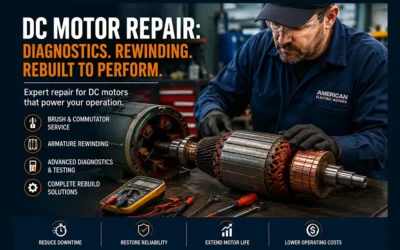
Stator rewinding is most commonly associated with AC motors because the stator carries the primary windings. DC motor construction differs. Traditional DC motors commonly use a wound armature and stationary field coils, so the required service may involve armature rewinding, field-coil repair, commutator work, or a complete rebuild.
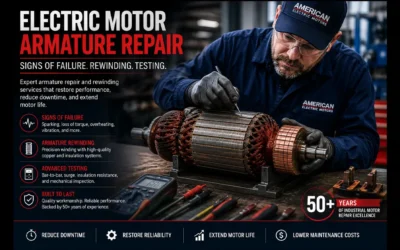
Facilities with both AC and DC equipment benefit from working with a repair provider that can identify the motor design and apply the correct procedure. Learn more about electric motor armature repair and rewinding or review our guide to DC motor repair.
Safety During Motor Inspection and Service
Industrial motor troubleshooting and repair should be performed by qualified personnel. Electrical energy, rotating components, stored mechanical energy, and connected machinery can cause serious injury. Before inspection or service, the equipment must be isolated according to the facility’s energy-control procedures. The OSHA lockout/tagout standard establishes requirements for controlling hazardous energy during servicing and maintenance.
Frequently Asked Questions About Electric Motor Stators
Can a damaged stator be repaired without a full rewind?
Sometimes. If damage is limited to leads, connections, insulation in a small accessible area, or another localized defect, a repair may be possible. Testing is required to determine whether the remaining winding is reliable.
How long does stator rewinding take?
Turnaround depends on motor size, winding complexity, damage, required materials, machine work, testing, and shop workload. Emergency service may be available for critical equipment, but an accurate schedule generally requires an inspection.
What information helps a repair shop evaluate a motor?
Provide clear nameplate photos, the application, operating voltage, symptoms, failure history, required turnaround, and any unusual shaft, brake, encoder, gearbox, or mounting details. Photos of the motor and driven equipment can also help with initial planning.
Should a stator be rewound after every winding fault?
No. The proper scope depends on test results and the condition of the core, insulation, connections, rotor, bearings, shaft, and frame. A qualified inspection should determine whether localized repair, rewinding, rebuilding, or replacement offers the best value.
Request Electric Motor Stator Testing or Repair
If you need help evaluating electric motor stators that are overheating, tripping, drawing unbalanced current, or failing under load, American Electric Motors can inspect the complete assembly and recommend repair, stator rewinding, rebuilding, or replacement. Our experienced team services industrial AC and DC motors across a wide range of sizes, brands, and applications.
Use our Sales and Service Request form or call 810-743-6080 to discuss your motor, application, and turnaround requirements.